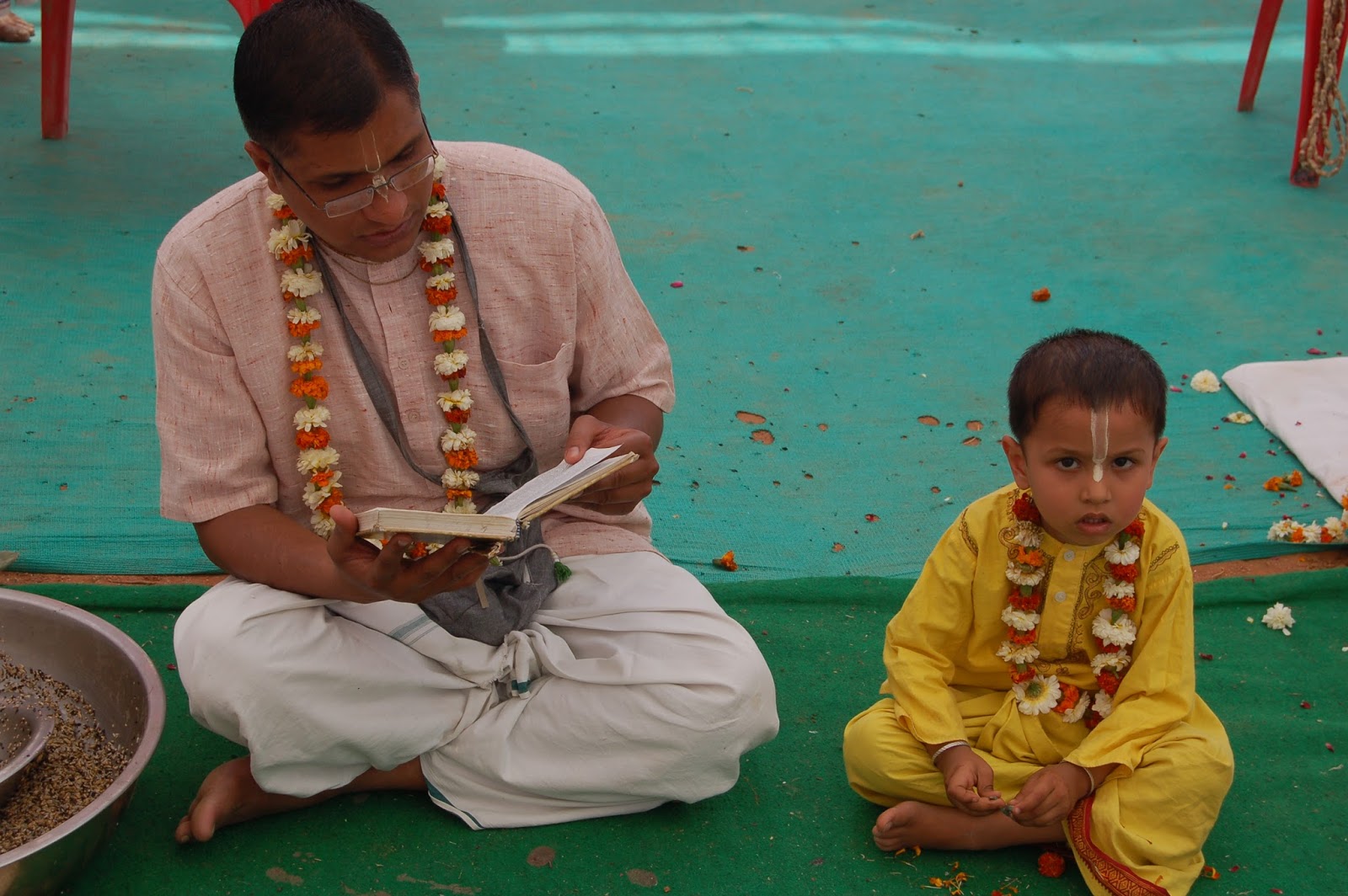
Thursday, 21 April 2016

Prasāda of Lord Viṣṇu


"If one is habituated to taking the prasāda of Lord Viṣṇu,
there is no chance of his becoming a ghost or anything lower than a human being." Śrīmad-Bhāgavatam 4.18.18

Wednesday, 20 April 2016

Bhāgavatam's conclusion is that a devotee is never disturbed


"When something is arranged by the Supreme Personality of Godhead, one should not be disturbed by it, even if it appears to be a reverse according to one's calculations. For example, sometimes we see that a powerful preacher is killed, or sometimes he is put into difficulty, just as Haridāsa Ṭhākura was. He was a great devotee who came into this material world to execute the will of the Lord by preaching the Lord's glories. But Haridāsa was punished at the hands of the Kazi by being beaten in twenty-two marketplaces. Similarly, Lord Jesus Christ was crucified, and Prahlāda Mahārāja was put through so many tribulations. The Pāṇḍavas, who were direct friends of Kṛṣṇa, lost their kingdom, their wife was insulted, and they had to undergo many severe tribulations. Seeing all these reverses affect devotees, one should not be disturbed; one should simply understand that in these matters there must be some plan of the Supreme Personality of Godhead. The Bhāgavatam's conclusion is that a devotee is never disturbed by such reverses. He accepts even reverse conditions as the grace of the Lord. One who continues to serve the Lord even in reverse conditions is assured that he will go back to Godhead, back to the Vaikuṇṭha planets."

Śrīmad-Bhāgavatam 3.16.37, Purport

Tuesday, 19 April 2016

Even a child can take part


"So take to this Kṛṣṇa, Hare Kṛṣṇa movement. It is very easy. Even a child can take part. You see. Those children, they are not born of brāhmaṇa family or this family or that family. Never mind. Because they are taking part in chanting and dancing, they are becoming purified. Every step of their dancing being noted, being noted."
Bhagavad-gītā 4.3 -- Bombay, March 23, 1974

Monday, 18 April 2016

Father's duty


"The father's duty is to see that the children, the son, is raised very nicely so that in future he may be very happy. This is the duty of the father, to see, not that simply to feed him and make him fatty. No. In the śāstra it is said, pitā na sa syāt. One should not become a father. This is contraceptive. Pitā na sa syāt jananī na sā syāt: "One should not become a father, one should not become a mother, one should not become a guru, one should not become a relative, one should not become a caretaker, one should not become the king..." Who? Na mocayed yaḥ samupeta-mṛtyum: "One who cannot protect the dependent from the clutches of death." This is sastric injunction. So how much the father and the government or the guru should be strong so that he can save his dependents from the clutches of death."
Śrīmad-Bhāgavatam 6.2.3 -- Vṛndāvana, September 7, 1975

Friday, 15 April 2016

"The worship of Lord Rāmacandra began from Mahārāja Ikṣvāku."


So Mahārāja Ikṣvāku, the first king of the dynasty in which Lord Rāmacandra took birth, very pious family. So Ikṣvāku Mahārāja... The worship of Lord Rāmacandra began from Mahārāja Ikṣvāku. Mahārāja Ikṣvāku used to worship the Deity of Rāmacandra, Rāma-Sītā. 
Therefore in their family Lord Rāmacandra appeared. That Deity is still existing in some part of South India. The Deity was being worshiped in the family since Mahārāja Ikṣvāku, and during when Lord Rāmacandra was personally present, this Deity was kept in His bedroom. 
So one brāhmaṇa, he used to come and see Lord Rāmacandra. Then he would take, break his fasting, breakfast. That was his principle, regulative principle. So Lord Rāmacandra was absent for a week or so from the kingdom, and the brāhmaṇa did not take even a little water because he could not see Lord Rāmacandra. Such a devotee. 

So Lakṣmaṇa informed King Rāmacandra that "Here is a devotee, brāhmaṇa. You were absent from the kingdom for one week, so he did not take even a drop of water." So Lord Rāmacandra was very much pleased. Then He ordered Lakṣmaṇa that "You give him that Deity which was being worshiped in our family, now it is stopped." So He delivered that Deity Rāmacandra to the brāhmaṇa, that "When Lord Rāmacandra is absent from the kingdom, you can worship." 

 Bhagavad-gītā 2.32 -- London, September 2, 1973

Monday, 11 April 2016

"War is not always Impious"


Prabhupāda: Not necessarily. I don't say that. That is different thing. But richness is due...

Guest (1): I understood what you said before.

Prabhupāda: Yes. Not necessarily that because a man is very rich, therefore he has got a very good brain also. No, not necessarily. Neither good brain can produce richness. Even there is one man, he's very intelligent man, but in the field of activities, he remains a poor man. So neither intelligence is the cause of richness, nor richness is the cause of intelligence. These are two different things. But if one is pious, then his, as reaction of his pious acts, he becomes rich, he becomes wealthy, he becomes beautiful, he becomes learned. These things are stated in the scriptures. Janmaiśvarya-śruta-śrībhiḥ [SB 1.8.26]. Janma-aiśvarya, four things, janma-aiśvarya-śruta... Janma means birth, aiśvarya means richness, and śruta means education. Is that point clear?
(drunk begins yelling in background)
Is that point clear? Please hear. Stop! Don't talk. We are talking seriously. Don't disturb. Is that point clear?

Guest (1): Yes.

Prabhupāda: Yes. Any other questions?

Young Woman: If one is really pious, why should he care about materialistic things such as beauty and wealth?


Prabhupāda: Hm? If one is pious, why he should?


Young Woman: Why should he care about things like beauty and wealth?

Prabhupāda: Oh. So war is not always impious. Do you understand? Sometimes war, fighting... So far, so far the Vedic conception of life is concerned, there are four classes, four classes: the intelligent class, the administrator class, the mercantile class... Not only Vedic religion, this division is all over the world. There are four classes of men. So for administrative class of men, it is a duty to protect the weak. Sometimes law and order required, violence. Just like the government maintains military, police force because sometimes they are required. So when government employs some police force, some military force, that does not means impious. That is required. Similarly, fighting or violence is not always impious. But a responsible person, he does not take violence unnecessarily. He considers things very nicely, and when there is no other alternative than to use violence, then he uses violence. Just like the government sometimes takes violence upon the citizens. It is not the objective of the government to... (end)

 Bhagavad-gītā 4.15 -- Bombay, April 4, 1974

Saturday, 9 April 2016

"That is called māyā."


So this pushing method is given by Caitanya Mahāprabhu personally, Kṛṣṇa personally. Jīv jāgo jīv jāgo gauracānda bole. Gauracandra, Caitanya Mahāprabhu, is asking everyone, "Wake up!" The same dreaming. "Wake up."
jīv jāgo jīv jāgo gauracānda bole
kota nidrā jāo māyā-piśācīra kole

"Why you are sleeping on the lap of this māyā, illusory energy? Why you are sleeping?" Jīv jāgo jīv jāgo gauracānda bole. "Get up."
bhajibo boliyā ese saṁsāra-bhitare
bhuliyā rohile tumi avidyāra bhare

When we were in the womb of our mother, the situation was so troublesome that we remembered at that time Kṛṣṇa. "Kṛṣṇa..."Just like when we are in great trouble we sometimes remember God. Similarly, that condition, packed-up condition, when the child's in the belly... You get consciousness back... Death means unconscious for seven months. That's all. That is death. There is no death. Death means I give up this body, enter the womb of another mother's body. And the mother nourishes by the materials..., the intestine joined with the belly. So mother supplies it through the pipe and the child grows. When it is fully grown, then he gets back his consciousness. So at that time it becomes very much troublesome to remain in that packed-up condition. So those who are pious, virtuous, they remember at that time, "O Kṛṣṇa, I am again put into this condition of..."(laughter) Oh, don't laugh. It is very serious subject. Try to understand.

So everyone has passed this condition, but by the influence of māyā forgets. Bhajibo boliyā ese saṁsāra-bhitare. Bhaktivinoda Ṭhākura says, "At that time again I promised: 'This time by coming out of my mother's womb, I shall become a devotee.' " But as soon as he comes out, he becomes forgetful. This is going on. This is going on. 

There is no science, so-called science, who know, the scientists, who know these are facts, how we are passing through repeatedly unpleasant condition. When, as soon as we get a little light with this body, we forget everything. That is called māyā. 
So Caitanya Mahāprabhu said the pushing, the point pushing, enechi auṣadhi māyā nāśibāro lāgi': "Now I have brought this.

 Śrīmad-Bhāgavatam 1.1.4 -- London, August 22, 1971