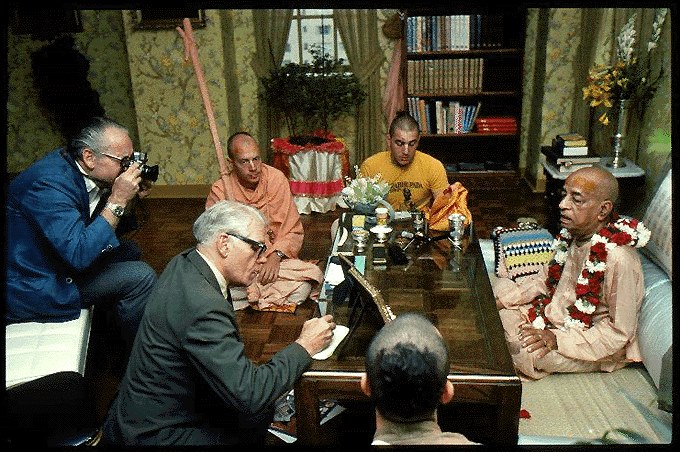
Friday, 19 February 2016
Wednesday, 17 February 2016
Let him go away
Devotee (8): Prabhupāda? Some of the people I've met... Like in the later volumes of Śrīmad-Bhāgavatam, some of the information is so much against what the living entities are experiencing and being educated in, that I've noticed that some people have turned away from Kṛṣṇa who already had some attraction when they hear these different topics, like the situation of the universe.
Prabhupāda: Hm? What is that?
Brahmānanda: That because in Śrīmad-Bhāgavatam the knowledge there contradicts the mundane scientific knowledge, people who had some faith in Kṛṣṇa become discouraged and turn away from Kṛṣṇa.
Prabhupāda: Let him go away. Don't care for him. Let all the fools go away. There is Bengali proverb, "Instead of maintaining some bad cows, let the cowshed be vacant." We shall prefer the cowshed vacant, no cow, than keeping all bad cows who does not give any milk, create disturbance.
Devotee (8): In our temple...
Prabhupāda: We are giving chance, but we don't want bad cows. We haven't got to agree with their views. They must agree with our views, then they can live. Otherwise let them go away. This is position.
Indian man (9): Your Divine Grace, are we all equal in sight of God?
Brahmānanda: Are we all equal in the eyes of God?
Prabhupāda: But if you become unequal, you must go away. No. His question was they are disturbed. So that means they are unequal. Why they should be disturbed?
Cyavana: Kṛṣṇa says, "All of them, as they surrender, I reward accordingly." So that means they are surrendering in different...
Prabhupāda: Yes. He has not surrendered. He keeps himself separate from Kṛṣṇa, and he is, artificially he shows surrender. Surrender does not mean that you reserve something for you. That is not surrender. Surrender means without reservation. That is surrender.
Devotee (8): Devotional service must be unconditional, or else it will drive us away.
Prabhupāda: Yes. Just like a child is surrendered to the parents. The parents say, "Sit down here." He sit down. That's all. No argument. That is surrender.
Srila Prabhupada's Morning Walk -- November 1, 1975, Nairobi — with Ramesh Sinfh.
Kṛṣṇa Consciousness means
"Kṛṣṇa consciousness means to work in full knowledge of one's relationship with the Supreme Absolute, and the perfection of this consciousness is full knowledge of Kṛṣṇa, or the Supreme Personality of Godhead."
-Bhagavad-gītā As It Is 5.29
"Receiving Kṛṣṇa consciousness means receiving light."
-Teachings of Lord Kapila Vs 14
"Kṛṣṇa consciousness means always thinking of Kṛṣṇa."
-TQK 8: Let There Be Calamities
"Kṛṣṇa consciousness means always living with Kṛṣṇa in His spiritual planet."
-PoP 9: Destination After Death
"Kṛṣṇa consciousness means one has to follow the footsteps of the devotees, sādhu-mārga-anugamanam."
-Śrīmad-Bhāgavatam 6.1.16 -- Denver, June 29, 1975
"Kṛṣṇa consciousness means it is declaration of fighting with māyā."
-Śrī Caitanya-caritāmṛta, Ādi-līlā 7.149-171 -- San Francisco, March 18, 1967
"Kṛṣṇa consciousness means to follow what Kṛṣṇa says."
-Speech to Devotees -- Vṛndāvana, April 7, 1976
"Krsna consciousness means that whatever condition of life I am in at present, that is Krsna's special mercy upon me."
-Letter to: Madhukara — Bombay 4 January, 1973
"Krsna Consciousness means to be on the platform of deathlessness."
-Letter to: Malati — Los Angeles 7 January, 1974
"Krsna Consciousness means one should be always very much anxious to calculate whether every moment of his life has not been utilized in devotional service."
-Letter to: Yamuna — Los Angeles 2 March, 1970
"Krishna Consciousness means attachment for Krishna and detachment for personal benefit, that's all."
-Letter to: Sri Govinda — Bombay 25 December, 1972
"Krishna consciousness means to increase the number of persons in Krishna consciousness."
-Letter to: Kirtanananda — New York 13 April, 1967
"Krishna consciousness means staunch faith both in Guru and Krishna."
-Letter to: Devananda — Delhi 27 September, 1967
"Krishna Consciousness means to get out of the material qualities and be reinstated in the spiritual nirguna activities."
-Letter to: Janardana — Los Angeles 21 January, 1968
"Krishna Consciousness means practical living, not something utopian or idealistic and vague. We simply do the needful, whatever pleases Krishna most, that's all."
-Letter to: Yajnesvara — Bombay 2 January, 1972
"Krishna Consciousness means we should always be satisfied and happy, not that we must work something impossible, becoming overburdened, and then because we are unhappy by so much trouble we lose enthusiasm altogether and give up all hope."
-Letter to: Tejiyas — Bombay 19 December, 1972
"Krishna consciousness means that everything including myself are different energies of the Lord and as such should be utilized for the purpose of Krishna."
-Letter to: Alfred Ford — Mayapur 28 October, 1974
"Krishna consciousness means to make one's life successful, as well as helping others to make their lives successful."
-Letter to: Mr. M.K. Kaul — Ahmedabad 28 September, 1975
"Kṛṣṇa consciousness means activity."
-PoP 1: Yoga as Action
"Kṛṣṇa consciousness means to become kind to everyone."
-Bhagavad-gītā 1.21-22 -- London, July 18, 1973
"Kṛṣṇa consciousness means don't try to satisfy your senses."
-Bhagavad-gītā 2.20-25 -- Seattle, October 14, 1968
"Kṛṣṇa consciousness means to understand things as it is. That's all."
-Śrī Īśopaniṣad, Mantra 1 -- Los Angeles, May 2, 1970
"Kṛṣṇa consciousness means he does not anymore eat anything which is not offered to Kṛṣṇa."
-City Hall Lecture -- Durban, October 7, 1975
"Kṛṣṇa consciousness means good-bye to this material world."
-Lecture Excerpt -- London, July 25, 1976
"Kṛṣṇa consciousness means all activities plus God. That's all."
-Lecture -- Seattle, October 11, 1968
"Kṛṣṇa consciousness means Bhagavad-gītā."
-Lecture — Los Angeles, July 11, 1971 (New-2003)
"Kṛṣṇa consciousness means to have all kinds of knowledge."
-Bhagavad-gītā 7.2 -- San Francisco, September 11, 1968
Tuesday, 16 February 2016
Today is Śrīpāda Madhvācārya's disappearance day
Śrīpāda Madhvācārya took his birth at Uḍupī, which is situated in the South Kanaraḍā district of South India, just west of Sahyādri. This is the chief city of the South Kanaraḍā province and is near the city of Mangalore, which is situated to the south of Uḍupī. In the city of Uḍupī is a place called Pājakā-kṣetra, where Madhvācārya took his birth in a Śivāllī-brāhmaṇa dynasty as the son of Madhyageha Bhaṭṭa, in the year 1040 Śakābda (A.D. 1119). According to some, he was born in the year 1160 Śakābda (A.D. 1239).
In his childhood Madhvācārya was known as Vāsudeva, and there are some wonderful stories surrounding him. It is said that once when his father had piled up many debts, Madhvācārya converted tamarind seeds into actual coins to pay them off. When he was five years old, he was offered the sacred thread. A demon named Maṇimān lived near his abode in the form of a snake, and at the age of five Madhvācārya killed that snake with the toe of his left foot. When his mother was very much disturbed, he would appear before her in one jump. He was a great scholar even in childhood, and although his father did not agree, he accepted sannyāsa at the age of twelve. Upon receiving sannyāsa from Acyuta Prekṣa, he received the name Pūrṇaprajña Tīrtha. After traveling all over India, he finally discussed scriptures with Vidyāśaṅkara, the exalted leader of Sṛṅgeri-maṭha. Vidyāśaṅkara was actually diminished in the presence of Madhvācārya. Accompanied by Satya Tīrtha, Madhvācārya went to Badarikāśrama. It was there that he met Vyāsadeva and explained his commentary on the Bhagavad-gītā before him. Thus he became a great scholar by studying before Vyāsadeva.
By the time he came to the Ānanda-maṭha from Badarikāśrama, Madhvācārya had finished his commentary on the Bhagavad-gītā. His companion Satya Tīrtha wrote down the entire commentary. When Madhvācārya returned from Badarikāśrama, he went to Gañjāma, which is on the bank of the river Godāvarī. There he met with two learned scholars named Śobhana Bhaṭṭa and Svāmī Śāstrī. Later these scholars became known in the disciplic succession of Madhvācārya as Padmanābha Tīrtha and Narahari Tīrtha. When he returned to Uḍupī, he would sometimes bathe in the ocean. On such an occasion he composed a prayer in five chapters. Once, while sitting beside the sea engrossed in meditation upon Lord Śrī Kṛṣṇa, he saw that a large boat containing goods for Dvārakā was in danger. He gave some signs by which the boat could approach the shore, and it was saved. The owners of the boat wanted to give him a present, and at the time Madhvācārya agreed to take some gopī-candana. He received a big lump of gopī-candana, and as it was being brought to him, it broke apart and revealed a large Deity of Lord Kṛṣṇa. The Deity had a stick in one hand and a lump of food in the other. As soon as Madhvācārya received the Deity of Kṛṣṇa in this way, he composed a prayer. The Deity was so heavy that not even thirty people could lift it. Madhvācārya personally brought this Deity to Uḍupī. Madhvācārya had eight disciples, all of whom took sannyāsa from him and became directors of his eight monasteries. Worship of the Lord Kṛṣṇa Deity is still going on at Uḍupī according to the plans Madhvācārya established.
Madhvācārya then for the second time visited Badarikāśrama. While he was passing through Maharashtra, the local king was digging a big lake for the public benefit. As Madhvācārya passed through that area with his disciples, he was also obliged to help in the excavation. After some time, when Madhvācārya visited the king, he engaged the king in that work and departed with his disciples.
Often in the province of Gāṅga-pradeśa there were fights between Hindus and Muslims. The Hindus were on one bank of the river, and the Muslims on the other. Due to the community tension, no boat was available for crossing the river. The Muslim soldiers were always stopping passengers on the other side, but Madhvācārya did not care for these soldiers. He crossed the river anyway, and when he met the soldiers on the other side, he was brought before the king. The Muslim king was so pleased with him that he wanted to give him a kingdom and some money, but Madhvācārya refused. While walking on the road, he was attacked by some dacoits, but by his bodily strength he killed them all. When his companion Satya Tīrtha was attacked by a tiger, Madhvācārya separated them by virtue of his great strength. When he met Vyāsadeva, he received from him the śālagrāma-śilā known as Aṣṭamūrti. After this, he summarized the Mahābhārata.
Madhvācārya's devotion to the Lord and his erudite scholarship became known throughout India. Consequently the owners of the Śṛṅgeri-maṭha, established by Śaṅkarācārya, became a little perturbed. At that time the followers of Śaṅkarācārya were afraid of Madhvācārya's rising power, and they began to tease Madhvācārya's disciples in many ways. There was even an attempt to prove that the disciplic succession of Madhvācārya was not in line with Vedic principles. A person named Puṇḍarīka Purī, a follower of the Māyāvāda philosophy of Śaṅkarācārya, came before Madhvācārya to discuss the śāstras. It is said that all of Madhvācārya's books were taken away, but later they were found with the help of King Jayasiṁha, ruler of Kumla. In discussion, Puṇḍarīka Purī was defeated by Madhvācārya. A great personality named Trivikramācārya, who was a resident of Viṣṇumaṅgala, became Madhvācārya's disciple, and his son later became Nārāyaṇācārya, the composer of Śrī Madhva-vijaya. After the death of Trivikramācārya, the younger brother of Nārāyaṇācārya took sannyāsa and later became known as Viṣṇu Tīrtha.
It was reputed that there was no limit to the bodily strength of Pūrṇaprajña, Madhvācārya. There was a person named Kaḍañjari who was famed for possessing the strength of thirty men. Madhvācārya placed the big toe of his foot upon the ground and asked the man to separate it from the ground, but the great strong man could not do so even after great effort. Śrīla Madhvācārya passed from this material world at the age of eighty while writing a commentary on the Aitareya Upaniṣad. For further information about Madhvācārya, one should read Madhva-vijaya, by Nārāyaṇācārya.
Śrī Caitanya-caritāmṛta, Madhya-lila 9.245
Monday, 15 February 2016
Bhīṣmadeva's advise
Bhīṣmadeva advised for all human beings nine qualifications:
(1) not to become angry,
(2) not to lie,
(3) to equally distribute wealth,
(4) to forgive,
(5) to beget children only by one's legitimate wife,
(6) to be pure in mind and hygienic in body,
(7) not to be inimical toward anyone,
(8) to be simple, and
(9) to support servants or subordinates.
One cannot be called a civilized person without acquiring the above-mentioned preliminary qualities.
Śrīmad-Bhāgavatam 1.9.26
Bhismastami - Appearance of Bhishmadeva
Geneology:
From Vishnu were descended in the following order - Brahma-Atri-Candra-Budha - Pururavas - Ayus - Nahusha- Yayati - Puru - Janamejaya - Prachinvaa - Pravira - Namasyu - Vitabhava - Shundu - Bahuvidha - Samyati - Rahovadi - Raudrasva - Matinara - Santurodha - Dushyanta - Bharata - Suhotra - Gala - Gardda - Suketu - Brhatksetra - Hasti - Ajamidha - Riksha - Samvarana - Kuru - Jahnu - Suratha - Vidaratha - Sarvabhauma - Jayatsena - Ravyaya - Bhavuka - Chakroddhata - Devatithi - Riksha - Bhima-Pratipa-Shantanu-Bhishma.
Birth and Boyhood:
Bhishma's name in his boyhood was Devavrata. He was the eighth son of Shantanu, a king of the lunar dynasty and Gangadevi. This boy was the human embodiment of Dyau, one of the Ashthavasus. Shantanu, his father was the re-birth of another king, Mahabhisheka. The story concerning this is given in the Mahabharata as follows:
King Mahabhisheka after his death, attained Vishnuloka. Once he went to visit Brahma at Satyaloka. At that time Ganga devi was also present in Brahma's assembly. In that pious atmosphere, a gentle breeze began to blow and Gangadevi's clothes were slightly deranged. Just at that moment Mahabhisheka took a stealthy glance at her and she also returned that glance. This was noted by Brahma who turned both of them into human beings by a curse. Gangadevi begged pardon and Brahma lifted the curse and blessed her that the Ashthavasus would come to the earth to be born as her sons and that afterwards she could come back to heaven. After that Gangadevi was born as a mortal woman in the world under the name Ganga and she spent her days in the forests near the Ganga river valleys.
In those days the ruler of the lunar dynasty was a king named Pratipa. Having no children he went to the bank of the Ganga and performed tapas there. Gangadevi who was moving about in the forests nearby, saw the king deeply absorbed in tapas. She approached him and sat on his right thigh. She wanted the king to be her husband. He explained to her that the right thigh is the proper seat of the daughter-in-law and so she would become his son's wife in due course. In due course of time, Pratipa has a son, Shantanu, born to him. When Shantanu grew up into a young man, one day he went for a hunt to the Ganga-valley and there he met Gangadevi. He fell in love with her at first sight and courted her. Gangadevi agreed to become his wife on the condition that he should not say anything to displease her and if he violated that condition she would leave him. The king accepted the condition and they became man and wife.
At about that time, the wife of Dyo, one of the Ashthavasus, happened to see the sacrificial cow of the sage Vasishtha and wished to have it. She expressed her desire to her husband, Dyo. Dyo with the other seven vasus went and took away by force Vasishtha's cow. Vasishtha in his anger cursed the Ashthavasus to be born as mortals. they repented and begged pardon from Vasishtha. The sage told them that all of them would be born as the sons of Gangadevi and all except Dyo, who actually stole the cow, would return to heaven at the time of birth itself. As for Dyo, he would continue to live in the world for a long time, as an adventurous hero.
Gangadevi became pregnant and gave birth to her first child. She carried the child to the river Ganga and threw it into the river. Shantanu who followed her up to the river bank, did not say anything against her, remebering his promise.
Seven children were born to her and she threw all of them into the river in this way. When she gave birth to the eighth child Shantanu insisted that he would not allow her to throw away that child in the river. As he had violated the conditions of his promise, the angry Gangadevi left the palace with her child. She named it Devavrata and brought him up in the forest. The sage Vasishtha and Gangadevi taught him all branches of knowledge. Thirtytwo years later, the king went to the same forest for hunting. He saw a handsome by stopping the flow of the river Ganga. Getting interested in the boy, the king approached him. But by that time he had disappeared. The king prayed to Gangadevi to give back the child. She appeared with the child and after handing over the child to him vanished. The king returned to the palace with the child (Mahabharata, Adi Parva, Chapters 95-100.)
The name of Bhishma:
Devavrata was anointed, as heir-apparent. One day king Shantanu reached the forest near the Ganga river valley, for hunting. As he was hunting absorbed in the beauty of the forest scenery, he felt the perfume of musk filling the air in the forest. He wondered from where it could come. He went on and on trying to find out the source of this smell until he reached the cottage of a fisherman. The fisherman had a daughter named Satyavati. It was from her that the fragrance of musk spread all around (Satyavati's original name was Kali. The fisherman got her from the stomach of a fish. Since she had a smell of a fish she got the name Matsyagandhi. She used to assist a fisherman in his work as a ferryman in the river Ganga. Once the sage Parasara happened to get into her boat and fell deeply in love with her. The sage removed the smell of fish from her and gave her the perfume of musk instead. By this mystic power he created a mist at noon and under its cover, he had a sexual union with her. As a result of it the child Krsna (Vyaasa) was born. The child immediately left the mother to perform tapas in the forest after promising to return to her whenever she wished for his presence. Although she gave birth to a child, Parasara blessed her that she would again remain a virgin. The whole episode remained a secret. As usual, Satyavati returned to the fisherman's cottage in the evening and continued to live with him. It is at this stage that Shantanu was attracted by the perfume of musk and came to the cottage where he met Satyavati.
The king fell in love with her at first sight. He asked the fisherman to give the girl in marriage to him. But the brave fisherman did not yeild to the king's demand immediately. He laid down several conditions; one of which was that Satyavati's sons should succeed to the throne of Shantanu. The king was in a fix. Devavrata was the eldest son and heir-apparent. To deny kingship to his sons would be highly improper. Unable to find a solution to this difficult problem, the king returned to the palace, much depressed and gloomy. there he avoided all company and took to his bed, passing his time in sadness and solitude.
When Devavrata knew about his father's condition, he called the Ministers and asked them about it. They told him everything in details. At once, without informing even his father, Devavrata went to the fisherman's cottage on the bank of the river Ganges and begged for Satyavati on behalf of his father. the fisherman repeated his former condition. Devavrata agreed that Satyavati's son shall be given the right of kinship. The fisherman pointed out that disputes were likely to arise between Devavrata's sons and Satyavati's children regarding the right of succession to the throne. At once Devavrata stood up and made a solemn pledge (drdavrata) that he would remain a bachelor for life. The fisherman gave Satyavati to Devavrata to be taken to the king. Devavrata took her to the palace and presented her to his father. The king, when he came to know of the part played by his son in that matter, rose from his bed and embraced Devavrata with tears of joy and gratitude. the gods showered flowers on the scene. Because he had taken such a solemn oath, it was decalred that henceforth he would be known by the name BHISHMA. The loving father Shantanu also gave him a boon that Bhishma would die only when he wished. (Mahabharata. Adi Parva, Chapter 100.)
Sunday, 14 February 2016
Love for Krishna
"....so long as we have got this material body we have to undergo these situations, if we increase our love for Krishna we shall be able to get out of this maya. People who therefore not exerting to improve Krishna Consciousness are simply wasting there valuable time and human life. Their human life is a chance to be out of the entanglements of material bodies. We get material bodies according to our activities, doggish men get the bodies of dogs in the next life, men in Krishna Consciousness get bodies like Krishna, so developed consciousness of human life is to concentrate of Krishna Consciousness so that we may be out of the clutches of material entanglement."
Letter to: Gargamuni -- Delhi 15 September, 1967
Subscribe to:
Posts (Atom)