Sunday, 28 September 2014

Sunday, 21 September 2014

'On seeing God'

Interviewer: Your Divine Grace, is the purpose of human life to realize God? 

Srila Prabhupada: Yes -- that is the only purpose.

Interviewer: Srila Prabhupada, have you realized God?

Srila Prabhupada: What do you think? What is your opinion?

Interviewer: I can't say.

Srila Prabhupada: Then if I say yes, what will you have understood? If you are not expert, then even if I say, "Yes, I am God-realized," how will you take it? If you do not know what God-realization is, then how can you ask this question, and how will you be satisfied by the answer? Therefore, you should not ask this question. It has no value -- unless, of course, you are prepared to accept whatever answer I give. Are you prepared? 

Interviewer: Yes.

Srila Prabhupada: Then it is all right. I am seeing God every moment. [Pause] But unless you are prepared to take the answer, you should not ask such questions.

Interviewer: Your Divine Grace, is meditation a means to realize God? 

Srila Prabhupada: Yes. Meditation is one means, but you cannot meditate now, because you do not know what God is. So how will you meditate? If you do not know what God is, upon whom will you meditate? First of all, you must know. We know God -- Krishna and Krishna says, man-mana bhava mad-bhaktah: "Always think of Me." So we meditate upon Krishna. That is perfect meditation, because meditation means to think of God. But if you do not know what God is, how can you think of Him? 

Interviewer: It is written in many scriptures that God is light.

Srila Prabhupada: God is everything. God is darkness, also. We say that God is that person from whom everything comes. So light comes from God, and darkness also comes from God. 

Interviewer: Do you think that meditation is a way to see God inside yourself? 

Srila Prabhupada: Yes. That is the description of meditation. Dhyanavasthita tad-gatena manasa pasyanti yam yoginah: by concentrating his mind, the yogi tries to see God within. So you must know what God is. Consider our ISKCON institution, for example. My disciples know what God is, so they can think of God. But if you have no idea of God, how will you think of Him?

Interviewer: This path of devotional yoga, bhakti-yoga -- is this the path for the present age?

Srila Prabhupada: Yes, bhakti-yoga is the real yoga. You'll find that when the yoga system is described in Bhagavad-gita, the Lord says, "The first-class yogi is he who is always thinking of Me, Krishna, within himself." So our students are being taught to think of Krishna always, twenty-four hours a day, without stopping. That is first-class yoga. 

Interviewer: If you are to think about something, you first have to see it. Do you show your devotees Krishna?

Srila Prabhupada: Oh, yes. Certainly. 

Interviewer: Then what ... well ... what is Krishna? What does He look like? 

Srila Prabhupada: See -- here is Krishna. 

Interviewer: But that's a painting. 

Srila Prabhupada: Yes, it is a painting. But suppose a painting of you were there. Could I not say, "Here is Mr. such-and-such"?

Interviewer: Yes.

Srila Prabhupada: Then what is the wrong there? Is your picture not yourself?

Interviewer: Yes, it is.

Srila Prabhupada: Similarly, this is Krishna’s painting. But the difference is that we cannot talk with your picture but we can talk with Krishna’s picture. That is the difference.

Interviewer: But still, somebody must have seen Krishna to actually paint Him. 

Srila Prabhupada: Yes. When Krishna was present on this earth, so many people saw Him. And since then, there have been so many temples of Krishna’s Deity, Krishna’s form. The same form described in the Vedic literature appeared personally, and the devotees made statues. These forms of Krishna are being worshiped regularly. There are thousands and thousands of Krishna temples. 

Interviewer: But has anybody actually seen Krishna?

Srila Prabhupada: Yes, yes -- just as your father has seen your grandfather. You may not have seen him, but your father can describe him -- "My father was like this." What is the difficulty? 

Devotee: He asked if anyone now has seen Krishna.

Srila Prabhupada: How can one see Him now? One has to see through the parampara, the disciplic succession. You have not seen your grandfather, so how do you know who he was?

Interviewer: Your parents tell you. 

Srila Prabhupada: Yes. So you have to receive knowledge about God from the authorities, from the parampara. 

Interviewer: But supposedly Krishna is eternal, so surely He exists today. 

Srila Prabhupada: Yes, Krishna is existing. At night the sun is existing, but you have no eyes to see it. That does not mean the sun does not exist. It is your deficiency -- you cannot see. 

Interviewer: So we need divine sight? 

Srila Prabhupada: You require qualification. Krishna always exists, but you require the qualification to see Him. That is described in the Vedic scriptures. Premanjana-cchurita-bhakti-vilocanena santah sadaiva hrdayesu vilokayanti: those who are saintly persons in ecstatic love with Krishna can see Him always, twenty-four hours a day. That is not very difficult to understand. If you love someone, you see him always. Is it not so? You need the qualification of love. Then Krishna will be visible twenty-four hours a day and talk with you. So you have to qualify yourself to hear Krishna, to see Krishna. But Krishna is always present.

This discussion between His Divine Grace A.C. Bhaktivedanta Swami Prabhupada and a reporter took place at ISKCON's center in Melbourne, Australia.

Sunday, 14 September 2014

"Allah is a Name of God"

In the opinion of Islamic theologians, Allah has 100 names but only 99 of them are revealed in different verses of the Holy Qur'an. The 100th name of Allah is hidden. Those who come to know this name can perform miracles. (O Gudratov, N. Gudratov, Mohammad Peygambar: Hayati va Kalamlari. Baki, 1990, p. 18)

Allah is a name of God

Srila Prabhupada: So what is this, Hare Krishna? Hare means the energy of the Lord, and Krishna means the Supreme Personality of Godhead. So, it is a prayer. There are three words only: Hare, Krishna and Rama. They have been arranged in sixteen words:

Hare Krishna Hare Krishna, Krishna Krishna Hare Hare,
Hare Rama Hare Rama, Rama Rama Hare Hare

So our movement is that we request you to take up these sixteen words — not sixteen words, three words, Hare, Krishna and Rama. But these are arranged in such a way that there are sixteen words. So, anyone can take them by heart, these three words, and chant them. It is universal. And if you think that "Oh, Krishna is the name of a Hindu god," if you have got any objection, then you may not chant Krishna, but you must have a name for God.

Just like the Muslims call Him Allah, the Jews call Him Jehovah, or somebody calls Him something else. That doesn't matter. If you think that "Why should I chant the Indian name Krishna, Sanskrit name Krishna?" So, Chaitanya Mahaprabhu says that there are millions and billions of names of God. If you think that this Krishna name is not very suitable, you can accept any name. That doesn't matter. Our proposition is you chant God's name. That is our proposal. Therefore, it is universal. If you like, you can chant Jehovah or you can chant Allah, but we request you that you chant God's name. Is it very difficult? It is not at all difficult.
Chaitanya Mahaprabhu said that there are innumerable names of God according to different languages, different countries, different societies. And each and every one of them has the potency of God Himself. If there is a God, He must be Absolute. Therefore, there is no difference between His name and He Himself. Just like in the material world, in the world of duality, there is a difference between the name "water" and the substance water. The name "water" is different from the substance water. If you are thirsty and you simply chant, "Water, water, water, water," your thirst will, not be quenched. You require the substance water. That is material, but spiritually, the name Krishna or the name Allah or the name Jehovah is as good as the Supreme Personality of Godhead. (Lecture, 15/06/68)

Srila Prabhupada: So I pleaded to the Muslim audience, "You can chant the name of Allah also. It's not necessary to have to chant the Krishna name, but any name indicating the Supreme Lord can be chanted." (Lecture, 20/03/75)

Srila Prabhupada: That's all right. Then our request is that you chant the name of God. So if Allah is the name of God, you chant Allah, don't chant Krishna. We say this. (Room conversation. Tehran, 14/03/75)

Srila Prabhupada: Just like Allah. If this name indicates God, then it is this word "Allah" which is as good as God. There is no difference. The Allah, the conception of Allah means the Great, is it not? So God is Great. So by chanting Allah, I am meaning God, the Supreme Person. So it is as good (as God). And actually in the Mosque, they chant Allah-u-Akbar, like that, so far as I've heard. So, that prayer, if it is not God's name, then what is the use of this prayer? That is God's name. Similarly, the Hindus may chant Hare Krishna, they're indicating to the same personality. It may be in a different language but it is as good as God because God is absolute. This name is authorised because Muhammad said, "You chant Allah." So it is authorised, because he is God's representative.
Therefore my request is, or our request is that you chant the name of Allah. We don't say that you have to chant Krishna. You chant the Holy name of God. If Allah is an approved name of God then you chant it. That is our request. We don't force you to chant the name of Krishna. No, we don't say that. If somebody says, "Jehovah is the name of God," that's all right, then you chant Jehovah. "Allah is the name of God," that's all right, you chant it We simply request that you chant the holy name of God. That's all. If you have got it, we don't force you to chant the name of Krishna. That is not our way. We accept, if Allah is God's name then it is as good as the name "Krishna." We are not so sophisticated that you have to chant this Krishna's name. No, we say: "Harer nama." That is the shastra (scripture). Harer noma means the name of the Lord. So, there are many thousands of names; that's a fact. So, we request you actually chant the name of God. Pick from millions of God's names. Whatever you like, you pick and chant. That is our propagation.

In this age of quarrel and disagreement, God realisation is very difficult. But if you chant the Holy name of God, then you'll gradually realise Him. This is our program. So, we don't force you to chant this name "Krishna," No. Shastra (scripture) says, harer nama — chant the holy name of God. That is our program.

Lady: Before your asked about something else. I want to ask, how could you meet the Supreme being by chanting...?

Srila Prabhupada: Yes. By chanting.

Lady: ...by chanting of a worldly name, tuned into a prayer... Srila Prabhupada: This is not a worldly name. Why do you make that mistake? God's name is not worldly. Lady: Because if you really know the tuning of God...

Srila Prabhupada: Do you think Allah is a worldly name?

Lady: We recognize it is before Krishna...

Srila Prabhupada: That's all right, you recognize it. Allah is not a worldly name. It is given by the authority, Muhammad. So you have to chant it, if you know God.

Lady: But he didn't really mean Allah is the name of God.

Srila Prabhupada: Why do you say that he didn't mean?

Lady: Because...

Srila Prabhupada: That is your say. Muhammad did not say, "What I say, I did not mean."

Lady: No, the name of God. He didn't mean Allah.

Srila Prabhupada: You say. Who cares for your word? Muhammad said this is the name of God. We have to accept, that's all.

Lady: So why...?

Srila Prabhupada: You cannot say, "He didn't mean." You are not a private secretary of Muhammad, (laughter)

Lady: So then how do they say that the name of God rests in God...

Srila Prabhupada: No, these things are not accepted.

Lady: Was before God...

Srila Prabhupada: Don't talk childish.

Lady: Was God.

Srila Prabhupada: (Whatever) Muhammad said that is authority. That we accept. We accept Muhammad as the representative of God. Whatever he says, we accept; that's all. What you mean, that is your business. But he is the authority; he said, "This is the name of God. You chant, you pray." Allah of God. That's all. That is authority. (Room conversation. Tehran, 14/03/75)

When the Holy Prophet Muhammad was asked about the most excellent Iman (faith), he answered: "To love him who loves God, and hate him who hates God, and to keep your tongue employed in repeating the name of Allah." (Abdullah al- Mamun al-Suhrawardy, The Sayings of Muhammad. London, 1905, p. 24)

Once the Holy Prophet said: "Pray to God morning and evening, and employ the day in your avocations." (Abdullah al-Mamun al-Suhrawardy, The Sayings of Muhammad. London, 1905, p. 2)

Monday, 8 September 2014

“Tulasi Devi never goes back to Godhead. She is always with Godhead”

6 January, 1972
Bombay

My Dear Radhaballabah das,

Please accept my blessings. I beg to acknowledge receipt of your first and second copies of your letter dated December 18th, 1971 which were sent to Bombay and Madras respectively.

I am very glad to know that you are seriously taking to Srimati Tulasi Devi worship. Tulasi Devi is a pure devotee of Krishna and she should be treated with the same respect given to all Krishna’s pure devotees. Simply by worshipping her faithfully, a devotee can get himself free of from all material miseries.

In the Nectar of Devotion I have given two verses from the Skanda Purana, one of which is: “Tulasi is auspicious in all respects. Simply by seeing, simply by touching, simply by remembering, simply by praying to, simply by bowing before, simply by hearing about, or simply by sowing the tree, there is always auspiciousness. Anyone who comes in touch with the Tulasi tree in the above mentioned ways lives eternally in the Vaikuntha world.”

So from this verse we can understand how pure is the service which Tulasi offers to Sri Krishna. So we should always endeavor after becoming servant of Tulasi Devi.

I do not know who has taught you that part of a Tulasi plant may be cut off and then replanted? From the Tulasi plant you can cut off only leaves for offering them to Krishna, never for cutting and planting. That is an offense. The manjaris (seeds) can be offered in water and it makes the water fragrant and tasteful. And the manjaris can be planted for growing new Tulasi plants.

Yes, the prayer you have enclosed is bona fide. Tulasi Devi never goes back to Godhead, she is always with Godhead. She is a pure devotee and thus she has appeared on this planet to render service to Krishna by being offered in all temples throughout the world by being offered up to the lotus feet of Krishna.

Chanting japa should be done early in the morning with full concentration preferably during the Brahma Muhurta time. Concentrate fully on the sound vibration of the mantra, pronouncing each name distinctly and gradually your speed in chanting will increase naturally. Do not worry so much about chanting fast, most important is the hearing. A devotee should always be grave and silent which means that he only discusses topics relating to Krishna Consciousness.

Yes, spend your time chanting and reading and taking Krishna Prasadam and automatically your tongue will come under control. If you sincerely engage 24 hours daily in devotional service according to the instructions of the Spiritual Master, chant daily 16 rounds, attend the arati ceremony of Lord Krishna, associate with the devotees and adhere strictly to the regulative principles then Krishna will reveal Himself personally to you.

I hope this meets you in good health.

Your ever well-wisher,
A. C. Bhaktivedanta Swami


Thursday, 4 September 2014

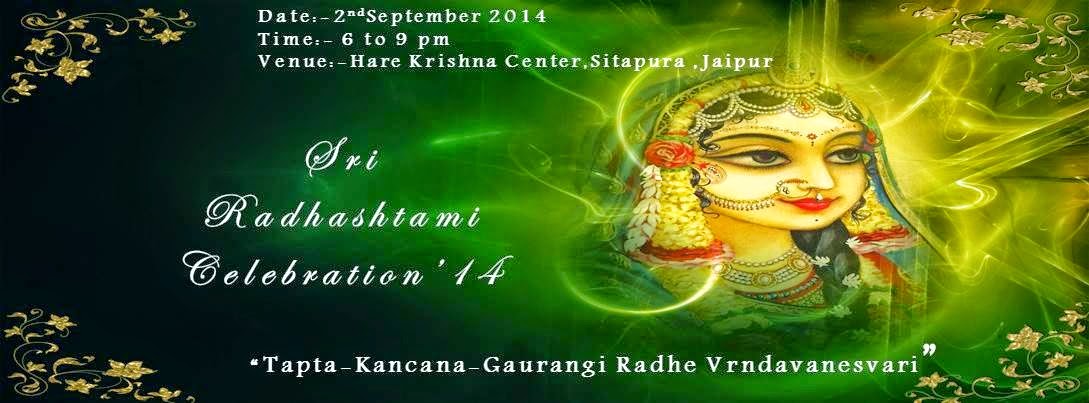
Radhastami Celebration 2014 @ Hare Krishna Center

Srila Prabhupada on the morning of Radhashtami
Many devotees came to attend the festival
Dayalu Nitai Das, President of Hare Krishna Community addressing the devotees
The main entrance of the temple being decorated with lights and flowers


                                                   Tulasi Arati on the eve of Radhashtami


Maha-Arati
Lamp being offered to the devotees


Devotees dancing and singing in Kirtan
The delicious offerings for Lord Radha and Krishna


Final Darshan
"Krishna Prasadam Ki Jay"

Tuesday, 26 August 2014

Upcoming Event: Sri Radhashastami


" Radha Rani’s twenty-five chief transcendental qualities are: (1) She is very sweet. (2) She is always freshly youthful. (3) Her eyes are restless. (4) She smiles brightly. (5) She has beautiful, auspicious lines. (6) She makes Kåñëa happy with Her bodily aroma. (7) She is very expert in singing. (8) Her speech is charming. (9) She is very expert in joking and speaking pleasantly. (10) She is very humble and meek. (11) She is always full of mercy. (12) She is cunning. (13) She is expert in executing Her duties. (14) She is shy. (15) She is always respectful. (16) She is always calm. (17) She is always grave. (18) She is expert in enjoying life. (19) She is situated at the topmost level of ecstatic love. (20) She is the reservoir of loving affairs in Gokula. (21) She is the most famous of submissive devotees. (22) She is very affectionate to elderly people. (23) She is very submissive to the love of Her friends. (24) She is the chief gopé. (25) She always keeps Kåñëa under Her control. In short, She possesses unlimited transcendental qualities, just as Lord Kåñëa does.'
Krishna  has sixty-four transcendental qualities. Çrématé Rädhäräëé has twenty-five transcendental qualities, but She can control even Kåñëa by them. Her transcendental qualities are as follows: (1) She is sweetness personified; (2) She is a fresh young girl; (3) Her eyes are always moving; (4) She is always brightly smiling; (5) She possesses all auspicious marks on Her body; (6) She can agitate Krishna by the flavor of Her person; (7) She is expert in the art of singing; (8) She can speak very nicely and sweetly; (9) She is expert in presenting feminine attractions; (10) She is modest and gentle; (11) She is always very merciful; (12) She is transcendentally cunning; (13) She knows how to dress nicely; (14) She is always shy; (15) She is always respectful; (16) She is always patient; (17) She is very grave; (18) She is enjoyed by Krishna; (19) She is always situated on the highest devotional platform; (20) She is the abode of love of the residents of Gokula; (21) She can give shelter to all kinds of devotees; (22) She is always affectionate to superiors and inferiors; (23) She is always obliged by the dealings of Her associates, (24) She is the greatest amongst Krishna's girl friends; (25) She always keeps Krishna under Her control.

Radharani..., today is Radharani's appearance day. So we should try to understand Radharani's feature. Radharani is the pleasure potency, hladini-sakti. Anandamayo 'bhyasat (Vedanta-sutra 1.1.12). In the Vedanta-sutra the Absolute Truth is described as anandamaya, always in pleasure potency. That anandamaya potency... Just like ananda. When you want ananda, pleasure, you cannot have it alone. Alone, you cannot enjoy. When you are in the circles of friend or family or other associates, you feel pleasure. Just like I am speaking. The speaking is very pleasing when there are many persons here. I cannot speak alone here. That is not ananda. I can speak here at night, dead of night, nobody here. That is not ananda. Ananda means there must be others. So because Krsna, the Absolute Truth, is anandamaya, therefore eko bahu syam, He has become many. We are also Krsna's part and parcel, to give pleasure to Krsna. And the chief pleasure potency is Radharani.
radha-krsna-pranaya-vikrtir hladini-saktir asmad
ekatmanav api bhuvo (pura) deha-bhedo-gatau tau
caitanyakhyam prakatam adhuna tad-dvayam caikyam aptam
radha-bhava-(dyuti)-suvalitam naumi krsna-svarupam
 [Cc. Adi 1.5]
So Krsna is Param Brahman, as you know from the Bhagavad-gita. When Arjuna understood Bhagavad-gita, he affirmed Krsna, param brahma param dhama pavitram paramam bhavan [Bg. 10.12]. So Krsna is Param Brahman. So in this material world we see that a great, saintly person, simply to enjoy brahmananda, he gives up everything of material enjoyment. He becomes sannyasi. Aham brahmasmi. Just to understand that he is in Brahman realization. So if one has to give up everything material for Brahman realization, do you think that Param Brahman, the Supreme Brahman, can enjoy anything material? No. Krsna's enjoyment is nothing material. This point should be understood. For Brahman realization we are giving up everything material. And how Param Brahman can enjoy anything material? This question has been very much nicely discussed by Jiva Gosvami.
So when the Param Brahman... First of all, the Param Brahman information is not there in this material world. Little Brahman information is there. Or little Paramatma information is there. But not Param Brahman, or Bhagavan, information. Therefore it is said, manusyanam sahasresu kascid yatati siddhaye [Bg. 7.3]. Siddhaye means to understand Brahman or Paramatma. But out of many such persons who have realized Brahman and Paramatma, hardly a person can know Krsna. And that... First of all... [break] ...what we can understand about Krsna's pleasure potency? If I want to know some big man. That is one process. And without knowing that big man, how I can understand about his internal affairs? Similarly, if we do not understand Krsna, how we can understand how Krsna is enjoying? That is not possible. But the Gosvamis, they're giving us information what is the pleasure potency of Krsna. That is Srimati Radharani.
So we have described about the Radha-Krsna loving affairs in our Teachings of Lord Caitanya in page 264. If you have got this book, you can read it, how the reciprocation of loving affairs of Radha-Krsna is there, transcendental. So our today prayer to Radharani... We pray to Radharani because She is the pleasure potency of Krsna. Krsna means "all-attractive." But Radharani is so great that She attracts Krsna. Krsna is all-attractive, and She is attractive (attractor) of Krsna. So what is the position of Srimati Radharani? We should try to understand this day and offer our obeisances to Radharani. Radhe vrndavanesvari.
tapta-kancana-gaurangi radhe vrndavanesvari
vrsabhanu-sute devi pranamami hari-priye
Our business is "Radharani, You are so dear to Krsna. So we offer our respectful obeisances unto You."
tapta-kancana-gaurangi radhe vrndavanesvari
vrsabhanu-sute devi pranamami hari-priye
[I offer my respects to Radharani, whose bodily complexion is like molten gold and who is the Queen of Vrndavana. You are the daughter of King Vrsabhanu, and You are very dear to Lord Krsna.]
Radharani is hari-priya, very dear to Krsna. So if we approach Krsna through Radharani, through the mercy of Radharani, then it becomes very easy. If Radharani recommends that "This devotee is very nice," then Krsna immediately accepts, however fool I may be. Because it is recommended by Radharani, Krsna accepts. Therefore in Vrndavana you'll find all the devotees, they're chanting more Radharani's name than Krsna's. Wherever you'll go, you'll find the devotees are addressing, "Jaya Radhe." You'll find still in Vrndavana. They are glorifying Radharani. They're more interested, worshiping Radharani. Because however fallen I may be, if some way or other I can please Radharani, then it is very easy for me to understand Krsna. Otherwise,
manusyanam sahasresu
kascid yatati siddhaye
yatatam api siddhanam
kascid vetti mam tattvatah
 [Bg. 7.3]
If you go by the speculative process to understand Krsna, it will take many, many lives. But if you take devotional service, just try to please Radharani, and Krsna will be gotten very easily. Because Radharani can deliver Krsna. She is so great devotee, the emblem of maha-bhagavata. Even Krsna cannot understand what is Radharani's quality. Even Krsna, although He says vedaham samatitani [Bg. 7.26], "I know everything," still, He fails to understand Radharani. Radharani is so great. He says that... Actually, Krsna knows everything. In order to understand Radharani, Krsna accepted the position of Radharani. Krsna wanted to understand the potency of Radharani. Krsna thought that "I am full. I am complete in every respect, but still, I want to understand Radharani. Why?" This propensity made Krsna obliged to accept the propensities of Radharani, to understand Krsna, Himself.
These are, of course, very transcendental, great science. One who is advanced in Krsna consciousness and well conversant with the sastras, they can understand. But still, we can discuss from the sastra. When Krsna wanted to understand Himself, He took the tendency of Srimati Radharani. And that is Caitanya Mahaprabhu. Radha-bhava-dyuti-suvalitam. Caitanya Mahaprabhu is Krsna, but He has accepted the propensities of Radharani. As Radharani is always in feelings of separation of Krsna, similarly, in the position of Radharani, Lord Caitanya was feeling separation of Krsna. That is the teachings of Lord Caitanya, feelings of separation, not meeting. The process of devotional service taught by Caitanya Mahaprabhu and His disciplic succession is how to feel separation from Krsna. That is Radharani's position, always feeling the separation.
The Gosvamis, they also, when they were in Vrndavana, they never said that "I have seen Krsna." Although they were the most perfect, they never said that "I have seen Krsna." Their prayers were like this: he radhe! vraja-devike! he nanda-suno! kutah. He radhe, Radharani, he radhe! vraja-devike! ca. Radharani does not remain alone. He (She) remains always with His (Her) friends, vraja-devi, Lalita or Visakha and other damsels of Vrndavana. So the Gosvamins are praying, in their mature stage, when they were living at Vrndavana, they were praying in this way, he radhe! vraja-devike! ca lalite! he nanda-suno! kutah: "Where, Radharani, where You are? Where are Your associates? Where You are, Nanda-suno, the son of Nanda Maharaja, Krsna? Where you are, all?" They were searching after. They never said, "I have seen Krsna dancing with the gopis. Last night I saw." (laughter) This is sahajiya. This is not mature devotee. This is called... They are called sahajiya. They take everything very cheap -- Krsna very cheap, Radharani very cheap -- as if they can see every night. No. The Gosvamis do not teach us like that. They're searching after. He radhe! vraja-devike! ca lalite! he nanda-suno! kutah, sri-govardhana-padapa-tale kalindi-vanye kutah: "Are you there under the Govardhana Hill or on the banks of the Yamuna?" Kalindi-vanye kutah. Ghosantav iti sarvato vraja-pure khedair maha-vihvalau. Their business was crying like this, "Where You are? Where You are, Radharani? Where you are, Lalita, Visakha, the associates of Radharani? Where You are, Krsna? Are You near Govardhana Hill or on the bank of the Yamuna?" Ghosantav iti sarvato vraja-pure. So throughout the whole tract of Vrndavana they were crying and searching after Them, khedair maha-vihvalau, as if madman. Khedair maha-vihvalau. Vande rupa-sanatanau raghu-yugau sri-jiva-gopalakau.
So we have to follow the footprints of the Gosvamis, how to search out Krsna and Radharani, Vrndavana, or within your heart. That is the process of Caitanya Mahaprabhu's bhajana: feeling of separation, vipralambha, vipralambha-seva. Just like Caitanya Mahaprabhu, feeling the separation of Krsna, He was falling down on the sea. He was coming out of His rest room or His bedroom and going out at dead of night. Nobody knew where He has gone. So that was His searching. This process of devotional service is taught by Caitanya Mahaprabhu. Not that very easily, "We have seen Krsna or seen Radharani in rasa-lila." No, not like that. Feel the separation. The more you feel separation from Krsna, you should understand that you are advancing. Don't try to see Krsna artificially. Be advanced in separation feeling, and then it will be perfect. That is the teachings of Lord Caitanya. Because with our material eyes we cannot see Krsna. Atah sri-krsna-namadi na bhaved grahyam indriyaih [Cc. Madhya 17.136]. With our material senses we cannot see Krsna, we cannot hear about Krsna's name. But sevonmukhe hi jihvadau. When you engage yourself in the service of the Lord... Where the service begins? Jihvadau. The service begins from the tongue. Not from the legs, eyes, or ears. It begins from the tongue. Sevonmukhe hi jihvadau. If you begin service through your tongue... How? Chant Hare Krsna. Use your tongue. Hare Krsna, Hare Krsna, Krsna Krsna, Hare Hare/ Hare Rama, Hare Rama, Rama Rama, Hare Hare. And take Krsna prasadam. The tongue has got two business: to articulate sound, Hare Krsna; and take prasadam. By this process you'll realize Krsna.
Devotee: Haribol!
Prabhupada: Don't try to see Krsna. You cannot see Krsna with your material eyes. Neither you can hear about Him with your material ears. Neither you can touch. But if you engage your tongue in the service of the Lord, then He'll reveal Himself to you: "Here I am." That is wanted. So feel separation of Krsna just like Radharani, as Lord Caitanya teaches us, and engage your tongue in the service of the Lord; then, one day, when you are mature, you'll see Krsna eye to eye.
Thank you very much.
Devotees: Haribol! All glories to His Divine Grace! (offer obeisances) (end)
Radhastami,
Srimati Radharani's Appearance Day

--